Your Brain on Subtitles: The Surprising Mental Upgrades That Come With Watching Asian Cinema
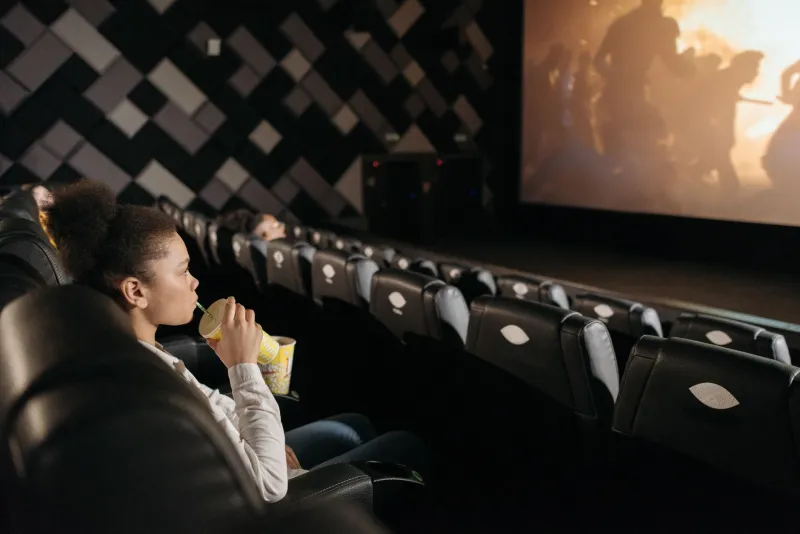
Let's be real — for a long time, subtitles had a reputation problem in America. The old complaint was always some version of "I don't want to read a movie." But somewhere between the global explosion of K-dramas, the slow burn of Thai noir, and the emotional gut-punch of Vietnamese family films finding their audience in the diaspora, that attitude quietly flipped. Subtitles aren't a dealbreaker anymore. For millions of American viewers, they've become second nature.
What nobody really talked about, though, was what all that subtitle-reading was actually doing to your brain.
Spoiler: it's a lot more than you'd expect.
Reading at Full Speed, on a Timer
Here's the thing about subtitles that makes them uniquely demanding — they don't wait for you. A standard subtitle line stays on screen for roughly one to seven seconds, depending on the length of dialogue. Your brain has to decode the text, absorb the meaning, and simultaneously process the visual story happening on screen. All at once. On a loop. For two hours.
That's not passive entertainment. That's a reading sprint.
Researchers studying media literacy and reading development have started paying closer attention to subtitle consumption, and the early findings are genuinely interesting. Studies out of European universities — particularly in Denmark and Belgium, where subtitled foreign content has been the norm for decades — have tracked measurable improvements in reading speed and comprehension among regular subtitle viewers compared to those who primarily watch dubbed content. The Danish model is especially relevant here: Danish children, who grow up watching subtitled English-language TV, consistently outperform expectations on English literacy benchmarks, despite English not being their native language.
While the American context is different, the underlying cognitive mechanics are the same. Reading under time pressure, repeatedly, in a context where you're emotionally invested in the story, appears to train the brain to process written language faster and more efficiently.
More Than Just Speed
Faster reading is one thing. But linguists and cognitive scientists are pointing to something deeper happening when you regularly consume subtitled content from a language and culture that's genuinely foreign to you.
Dr. Rosenblum, a language acquisition researcher who has spoken publicly about media's role in multilingual development, has noted that processing subtitles alongside a foreign-language audio track creates a kind of "dual-channel" cognitive demand. Your brain is essentially triangulating — matching spoken rhythm and emotional tone with on-screen action and written text simultaneously. Over time, that triangulation builds stronger neural pathways for contextual comprehension. You get better at reading between the lines, not just the lines themselves.
For diaspora viewers watching Vietnamese, Filipino, or Thai films, there's an added layer. Many second-generation viewers are navigating a heritage language they partially understand alongside English subtitles. That code-switching exercise — catching a familiar phrase in Vietnamese while reading its English equivalent — is a form of active bilingual processing that researchers associate with improved executive function and cognitive flexibility.
In plain terms: your brain gets better at holding multiple ideas at once and switching between them quickly. That's not a small thing.
The Comprehension Effect Nobody Talks About
Here's where it gets really interesting for fans of Asian cinema specifically. Unlike Hollywood blockbusters, which often lean on spectacle to carry the narrative, a lot of Asian films — particularly Korean thrillers, Japanese slow-cinema, or Vietnamese period dramas — demand a different kind of attention from viewers. The storytelling can be layered, the cultural references dense, and the emotional subtext sometimes operates in ways that don't translate literally.
To follow a film like Parasite, or a slow-burn Vietnamese drama about intergenerational family conflict, you can't zone out. The subtitles are your lifeline, and missing even a few seconds means losing the thread. So you pay attention differently. You read more carefully. You make inferences. You hold context in your head across long stretches of a film.
That habit — building and maintaining a mental model of a complex story while actively reading — is functionally similar to what strong readers do with dense literary fiction. And it's a skill that transfers. Students who are heavy subtitle viewers have reported anecdotally that they find it easier to follow complex academic texts, legal documents, or technical writing. The cognitive stamina built in a two-hour Korean crime drama apparently has real-world applications.
The Stigma Flip That Changed Everything
What's culturally fascinating about this moment is how completely the conversation has reversed. A decade ago, recommending a subtitled film to a casual American viewer often came with an automatic apology — "I know there are subtitles, but..." Now, among younger audiences especially, subtitles are often seen as a marker of quality. The assumption has shifted: if it's subtitled and it's from Asia, it's probably worth your time.
That shift has created a feedback loop. More Americans are watching subtitled Asian content. More of them are developing the reading fluency that makes it easier and more enjoyable. And that fluency is making them more open to films that are linguistically and culturally challenging — the kind of films that actually reward the cognitive investment.
Platforms that carry Asian cinema have noticed. The audience retention data on subtitled Asian films has improved significantly over the past few years, suggesting that viewers are not just clicking — they're staying, finishing, and coming back for more.
What This Means for How We Talk About Asian Film
For years, the conversation around Asian cinema in America has focused on the barriers — the subtitle resistance, the cultural unfamiliarity, the lack of mainstream distribution. And those barriers are real. But there's a parallel story that's worth telling more loudly: the people who pushed through those barriers didn't just discover great movies. They may have actually made themselves better thinkers in the process.
That's a different kind of argument for Asian cinema than the usual "you're missing out" pitch. It's not just about the films being good, though they often are. It's about what the act of watching them does to you over time.
So the next time someone gives you grief for reading your way through a three-hour Vietnamese epic or a densely plotted Japanese crime series, feel free to explain that you're not just watching a movie. You're training your brain.
And honestly? The movies are pretty great too.